Anti Money Laundering (AML) And KYC Concepts
By 2026, over 70% of UK financial institutions face increased scrutiny over anti money laundering compliance, highlighting the need for skilled professionals. In financial and business roles, that gap is the difference between decisions made with clarity and those made with costly uncertainty. The Anti Money Laundering (AML) And KYC Concepts course from EduXpress is a fully CPD-accredited, online programme designed for UK learners ready to build structured expertise, meet sector standards, and advance with the kind of grounded, practical knowledge that employers value.
This course covers key AML and Know Your Customer (KYC) principles, including legislation, risk assessment, customer due diligence, and reporting responsibilities. You will build practical knowledge and confidence to understand and apply AML controls effectively.
Flexible online CPD learning allows you to study at your own pace with full tutor support. Upon completing the assessment, you can obtain a CPD-accredited certificate to demonstrate your knowledge and skills.
Learning Outcomes of Anti Money Laundering (AML) And KYC Concepts
Upon completion of this Anti Money Laundering (AML) And KYC Concepts from EduXpress, learners will be able to:
Why Choose Our Anti Money Laundering (AML) And KYC Concepts Course?
Who is This Anti Money Laundering (AML) And KYC Concepts For?
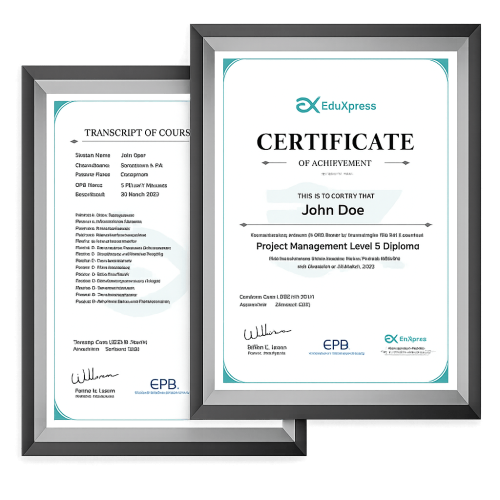
Certification: Anti Money Laundering (AML) And KYC Concepts
Upon successful completion of the final assessment, you will get a chance to order a CPD-accredited certificate confirming your achievement. This certificate is available in PDF as well as hard copy format, making it suitable for adding to your professional portfolio or CV.
Career Path
Frequently asked questions
Everything you need to know about the Anti Money Laundering (AML) And KYC Concepts
1. What is the primary purpose of Anti Money Laundering (AML) regulations?
The primary purpose of Anti Money Laundering (AML) regulations is to prevent criminals from disguising illegally obtained funds as legitimate income. AML laws require financial institutions and businesses to implement controls that detect and report suspicious activities, thereby protecting the financial system from money laundering and terrorist financing threats globally.
2. Why is Know Your Customer (KYC) important in AML compliance?
Know Your Customer (KYC) is essential in AML compliance because it verifies the identity of clients to prevent fraud and illegal activities. KYC processes help organizations understand their customers’ backgrounds, enabling them to assess risks and monitor transactions effectively, which is crucial for meeting regulatory standards in financial sectors worldwide.
3. Who must comply with AML and KYC regulations?
Financial institutions, banks, insurance companies, and businesses involved in financial transactions are required to comply with AML and KYC regulations. These entities must implement policies and procedures to identify, monitor, and report suspicious activities to regulatory authorities, ensuring adherence to local and international anti-money laundering laws.
4. How does AML training benefit employees in financial institutions?
AML training equips employees with the knowledge to identify and report suspicious transactions, reducing the risk of money laundering within the organization. It ensures staff understand regulatory requirements, enhancing compliance and protecting the institution’s reputation, which is vital for maintaining trust in financial markets globally and locally.
5. What are common red flags indicating potential money laundering?
Common red flags include unusually large cash transactions, inconsistent customer information, complex ownership structures, and transactions lacking economic rationale. Recognizing these indicators helps organizations detect potential money laundering activities early, ensuring timely reporting to authorities and compliance with AML regulations across different jurisdictions.
6. How often should AML and KYC policies be updated?
AML and KYC policies should be reviewed and updated at least annually or whenever there are significant regulatory changes. Regular updates ensure continued compliance with evolving laws and emerging risks, maintaining the effectiveness of anti-money laundering programs and protecting organizations in various geographic locations.
7. Can technology improve AML and KYC processes?
Yes, technology significantly enhances AML and KYC processes by automating customer verification, transaction monitoring, and risk assessment. Advanced tools like AI and machine learning improve accuracy and efficiency, enabling organizations to detect suspicious activities promptly and comply with regulatory requirements across global financial markets.
8. What consequences do organizations face for non-compliance with AML and KYC laws?
Organizations that fail to comply with AML and KYC laws may face severe penalties, including hefty fines, legal action, and reputational damage. Non-compliance can also lead to operational restrictions and loss of licenses, emphasizing the importance of adhering to anti-money laundering regulations to maintain business continuity and trust.
Curriculum
- 3 Sections
- 0 Lessons
- Lifetime
- Anti Money Laundering (AML) And KYC Concepts0 Items
- Order Your Certificate!0 Items
- Leave a Review!0 Items