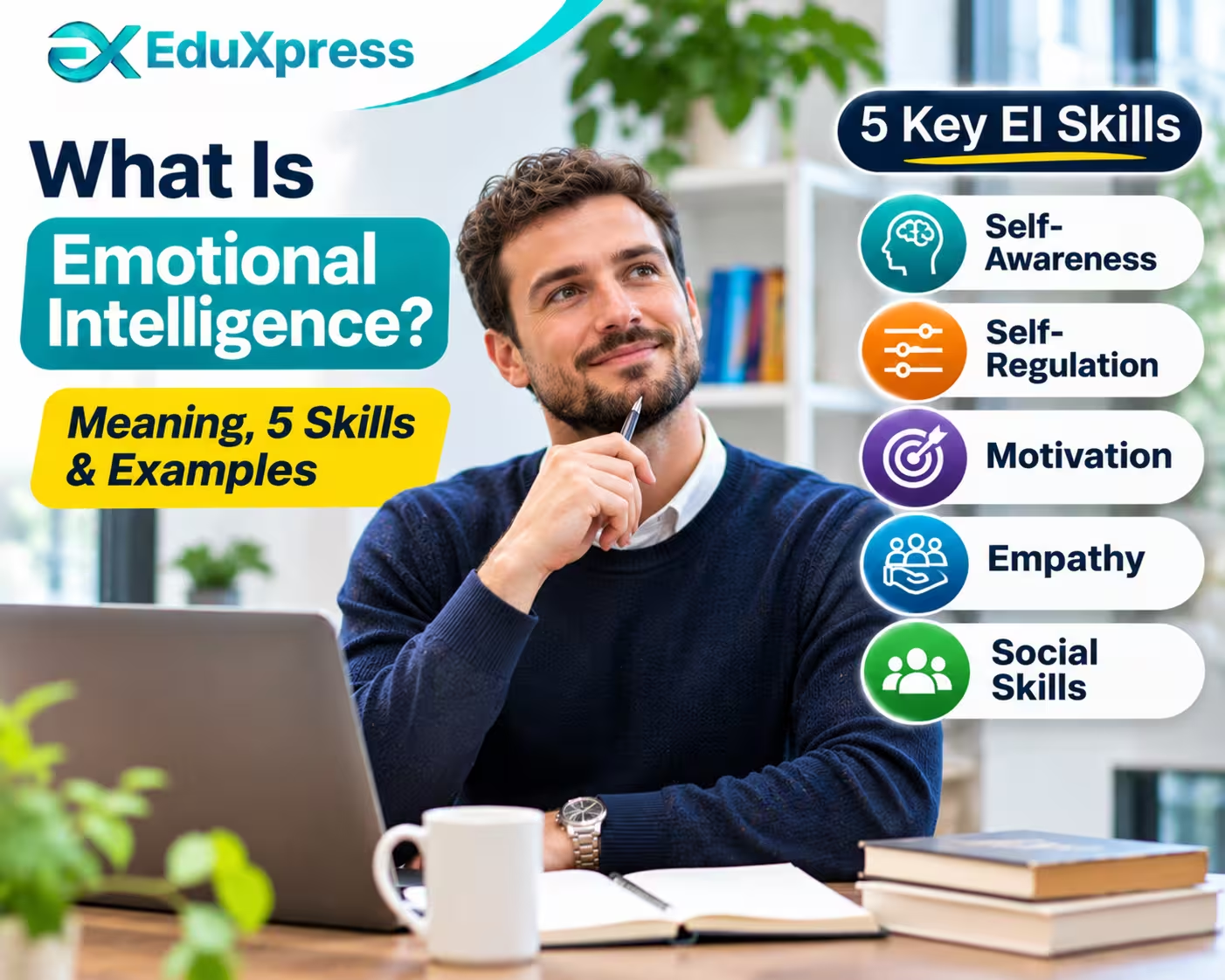
Emotional intelligence is the ability to notice, understand and manage emotions in yourself, while recognising emotions in others and responding thoughtfully. It can help you listen more carefully, handle disagreement and choose constructive actions when feelings run high. You do not need to hide emotions or agree with everyone to practise it.
Imagine receiving sharp feedback five minutes before an important meeting. One reaction is to defend yourself immediately; another is to identify the embarrassment, clarify the feedback and decide what to do next. This guide explains the meaning of emotional intelligence, its main models and how to practise it through original workplace and everyday exercises.
What does emotional intelligence mean?
Emotional intelligence concerns how we process emotional information. It includes detecting feelings, understanding what may have caused them, choosing suitable responses and considering how our actions affect other people. Some researchers study EI as a set of mental abilities; popular workplace models also include motivation, empathy and relationship skills.
For example, an employee notices feeling defensive during a performance review. Rather than denying that reaction, they ask for one concrete example and agree on a next step. Emotional awareness has changed behaviour. It has not made criticism pleasant, but it has made the conversation more useful.
People sometimes use “EQ” as though it were a single universally agreed score. It is not. Different tests measure different things, including self-perceived traits and performance on emotion-related tasks. The research review on EI measurement explains why definitions and assessments need care.
What are the five components of emotional intelligence?
Daniel Goleman’s widely used workplace description brings together five components. They are helpful for explaining everyday behaviour, although they are not identical to every scientific model of EI.
| Component | Meaning | Real-world example |
|---|---|---|
| Self-awareness | Noticing feelings and triggers | Recognising that criticism makes you anxious |
| Self-regulation | Choosing how to respond | Taking time before replying to an upsetting email |
| Motivation | Working towards meaningful goals | Continuing to practise a difficult presentation |
| Empathy | Considering another perspective | Asking a quiet colleague what support they need |
| Social skills | Managing interactions effectively | Giving respectful feedback and resolving disagreement |
These skills interact. Someone may be excellent at recognising feelings but struggle to express a boundary. Another may speak confidently yet misread what a colleague needs. Effective emotional intelligence depends on both awareness and action.
Goleman’s five components vs the four-branch model
The two explanations are often mixed together. The research-based ability model associated with Mayer, Salovey and Caruso focuses on perceiving, using, understanding and managing emotions. Goleman’s broader workplace framework describes five useful personal and interpersonal competencies, including motivation and social skills.
| Model | Core focus | Best used for |
|---|---|---|
| Four-branch ability model | How someone reasons about emotional information | Understanding psychological research and ability-based assessment |
| Five-component workplace model | How awareness, self-control, motivation and relationships appear at work | Coaching, reflection and practical development |
Neither framework should be used to label someone as a “bad employee” or diagnose a mental health condition. The Open University’s workplace guide provides further context on why EI has attracted research interest.
What are examples of emotional intelligence?
The clearest examples show a person doing something different after noticing an emotion.
Example: A disappointed customer
Unhelpful: “That is our policy. There is nothing I can do.”
Stronger response: “I can see this is frustrating. Let me check the options available under our returns policy.” The worker acknowledges the feeling without promising an exception.
Example: A teammate misses a deadline
Unhelpful: “You never take your work seriously.”
Stronger response: “The report was due yesterday, and the delay affected the handover. What got in the way, and how can we avoid it next time?” Facts replace mind-reading.
Example: You receive unexpected criticism
Unhelpful: Interrupting to explain why every complaint is wrong.
Stronger response: “I’m disappointed, but I want to understand. Could you show me one example and the standard you expect?”
These are illustrative scripts, not magic phrases. Tone, safety, culture and context still matter.
Why is emotional intelligence important at work?
Emotionally demanding moments affect teamwork, service quality and leadership. Recognising frustration early can help a worker ask for clarification instead of escalating an argument; noticing a worried colleague can prompt a supportive conversation rather than an assumption that they are disengaged.
Research supports the possibility of improvement. A 2024 systematic review and meta-analysis examined 50 workplace training studies and reported moderate improvements in emotional competencies. Its authors also highlighted considerable variation between studies and limitations in research quality. Therefore, training can be promising without guaranteeing better performance, wellbeing or promotion for every participant.
Emotional intelligence also has limits: workload, discrimination, unsafe management and inadequate staffing cannot be solved by asking workers to become more empathetic. Organisational systems and fair treatment remain essential.
Is emotional intelligence the same as empathy?
No. Empathy means making an effort to understand another person’s perspective or feelings. Emotional intelligence also includes understanding and managing your own emotional responses. You can empathise with an upset customer and still explain that a refund is not available under the applicable policy.
Compassion takes understanding further by motivating helpful action. Sympathy usually means feeling concern for someone. The distinctions are useful in caring roles: listening attentively matters, but so do consent, confidentiality and professional boundaries. For example, EduXpress’s guide to professional boundaries in health and social care explores how warmth and clear limits can coexist.
The EduXpress PAUSE method for emotional situations
This original five-part practice tool turns emotional awareness into a specific response. It is a learning aid rather than a clinically validated psychological scale.
P — Pinpoint: Name the emotion precisely: irritation, shame, uncertainty or worry. “Bad” is less useful than “I feel overlooked.”
A — Assess: Separate what happened from the meaning you assigned. “The manager postponed my meeting” is a fact; “They do not respect me” is an interpretation.
U — Understand: Consider alternative explanations and the other person’s perspective. Do not presume to know their thoughts.
S — Select: Choose a response that is respectful, proportionate and aligned with your goal, such as asking a question or requesting time.
E — Evaluate: Afterwards, ask what helped, what escalated the situation and what you could change next time.
Try it: A colleague replies “Fine” to a detailed message. Rather than assuming anger, write down two alternative explanations and ask a neutral follow-up only if clarification is needed.
How can you regulate emotions without suppressing them?
Self-regulation is not pretending to be calm. It involves noticing an internal reaction and choosing what to do with it. Start with your body: faster speech, clenched hands or a sudden urge to interrupt may be useful personal warning signs. Their meaning varies by individual.
When a discussion becomes heated, slow your speaking pace, take a short pause or request a brief break when appropriate. Label the feeling privately, focus on the specific problem and decide whether to talk now or later. Afterwards, reflect on the trigger. Avoid using these techniques to tolerate threats or harassment; follow reporting and safety procedures when needed.
For a structured growth plan, use EduXpress’s personal development plan template to record a realistic skill goal, an action and the evidence you will review.
How does emotional intelligence help resolve conflict?
Conflict often escalates when people treat assumptions as facts. The most practical EI habit is to describe the observable problem, invite another account and agree a workable next step.
Original workplace dialogue
Supervisor: “The shift handover was missing two entries, so the next team had to chase details.”
Colleague: “We were short-staffed. I thought someone else would finish them.”
Supervisor: “Thanks for explaining. How should we allocate the entries when staffing is tight?”
Outcome: Both parties can discuss responsibility without accusing the other of being lazy or uncaring.
Emotionally intelligent communication does not mean avoiding difficult conversations. It means making disagreement more precise and constructive. If a pattern involves bullying, unsafe practice or discrimination, normal dispute-resolution scripts may be insufficient; use the proper organisational procedure.
Emotional intelligence in leadership and management
Leaders influence how safe people feel raising concerns, asking questions or admitting mistakes. A manager who reacts defensively to bad news may unintentionally discourage staff from reporting problems. One who listens first, checks facts and communicates decisions clearly may make discussions more productive.
Consider a team member who has become quiet in meetings. An unhelpful leader might conclude that they lack motivation. A more thoughtful approach is: “I have noticed you have spoken less recently. Is there anything about our meetings that makes it difficult to contribute?” The employee may have no problem at all—and must be free to say so.
Strong leadership still requires competence, fairness and accountability. Emotional intelligence complements those responsibilities; it cannot replace them. NHS England’s compassionate conversations guide is a useful example of listening-based support.
Emotional intelligence in emails and remote teams
Digital communication removes clues such as tone, timing and facial expression. A short reply might signal annoyance, but it may simply mean someone is busy. Emotionally intelligent behaviour is to avoid building a story from incomplete evidence.
Original email exercise: Your colleague writes, “Need to talk about your report.” Before replying, list what is known (they want a conversation) and what is unknown (the reason, urgency and tone). Then choose a neutral response: “Of course. Is there anything you would like me to prepare before we speak?” This is more useful than sending a defensive explanation.
In video meetings, allow extra space for different communication styles. Some colleagues process questions slowly, use captions or prefer to contribute in writing. Do not equate camera use, eye contact or speed of reply with commitment. Ask people what helps them participate and provide accessible ways to respond.
Emotional intelligence in health and social care
In care settings, emotions can signal unmet needs, but they do not automatically reveal a diagnosis, intention or consent. A distressed resident may be frightened, uncomfortable, in pain or reacting to something in their environment. A worker should observe, ask accessible questions, follow the care plan and escalate concerns appropriately rather than guessing.
Imagine a relative who is angry about a delayed update. A useful response is to acknowledge their worry, explain what information can be shared, and offer to connect them with the authorised team. Empathy does not override privacy rules. EduXpress’s confidentiality in health and social care guide explains how appropriate information sharing supports trust and safety.
Skills such as emotional awareness, calm communication and respectful professional limits help care workers remain compassionate without overstepping their role.
Can you measure emotional intelligence with an EQ test?
There are ability-based assessments, personality-style questionnaires and mixed-model tools, but they are not interchangeable. A self-rating such as “I am a good listener” measures a personal judgement, not necessarily how effectively someone listens in real conversations.
Be cautious about free online “EQ scores”, especially when they do not explain what they measure or provide evidence of reliability. Scores should not be used casually to diagnose someone, decide whether they have a mental health condition or make high-stakes employment decisions. Research on different EI measurement approaches shows why interpretation matters.
Try this original emotional intelligence self-check
This short worksheet is for reflection only; it is not a psychometric test. Rate each statement as rarely, sometimes or usually, then choose one behaviour to practise.
- I can name my emotions more precisely than “good” or “bad”.
- I can identify a trigger without automatically blaming another person.
- I check my interpretation before assuming what someone feels.
- I can acknowledge another person’s concern without surrendering a reasonable boundary.
- I can repair a conversation after reacting poorly.
Worked example: If “I check my interpretation” is rated rarely, your practical goal could be: “For the next five working days, ask one neutral clarifying question before responding to an ambiguous message.” The purpose is observable progress, not a total EQ score.
A seven-day emotional intelligence development plan
| Day | Five-minute activity | Evidence to notice |
|---|---|---|
| Monday | Name three emotions during the day | More precise emotional vocabulary |
| Tuesday | Write one fact and one interpretation | Fewer unsupported assumptions |
| Wednesday | Listen without interrupting once | A clearer summary of the other person’s point |
| Thursday | Practise a respectful boundary | Clearer language without hostility |
| Friday | Use PAUSE in a minor disagreement | A constructive next step |
| Saturday | Reflect on a misunderstanding | One alternative explanation |
| Sunday | Choose a repeatable habit for next week | A simple, measurable goal |
Small, repeatable actions are more realistic than trying to change your personality in a week. If an exercise becomes overwhelming, skip it and seek appropriate support rather than forcing yourself to continue.
Common misconceptions about emotional intelligence
“Emotionally intelligent people never get angry.” False. Anger may be understandable; the skill is choosing a safe, proportionate response.
“Empathy means agreeing.” False. You can understand someone’s disappointment and still maintain a fair decision.
“Good eye contact proves honesty.” False. Eye contact varies across individuals, cultures and disabilities. Ask rather than infer motives from a single gesture.
“A high EQ score guarantees good leadership.” False. EI is only one part of effective professional behaviour, and different assessments have different limitations.
Frequently asked questions about emotional intelligence
Final thoughts: use emotional awareness in action
Emotional intelligence is most useful when it changes everyday behaviour: naming your feelings accurately, checking assumptions, listening to other perspectives and choosing proportionate responses. Begin with one interaction this week. Practise, review and adjust rather than chasing a perfect EQ score.