
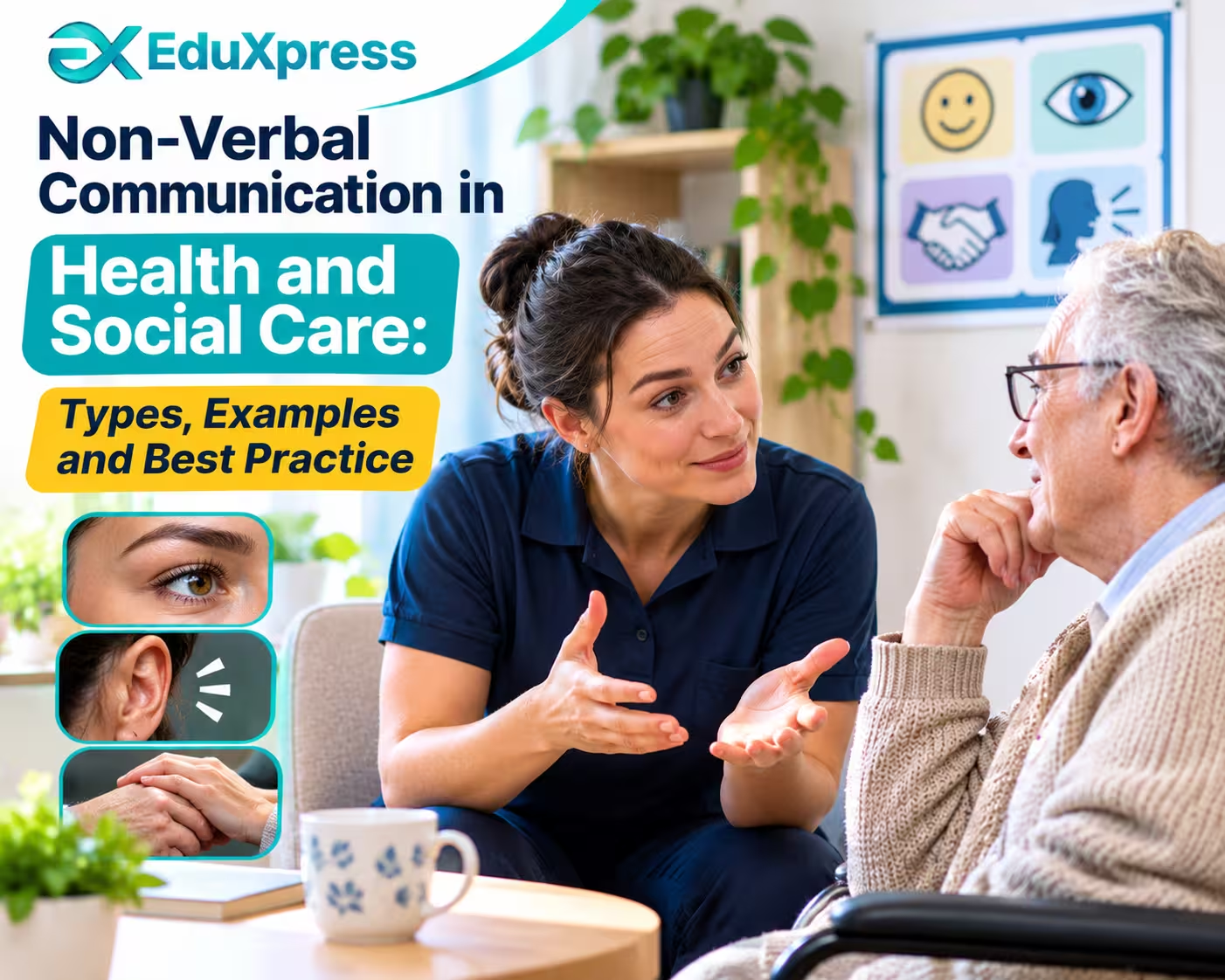
A smile, a change in posture or a hand moving away can change the course of a care interaction. Yet it is easy to misread these signals, especially when someone is in pain, has dementia or communicates without speech. This UK-focused guide explains non-verbal communication in health and social care through examples, current standards and practical responses, including an original observation framework.
What Is Non-Verbal Communication in Health and Social Care?
Non-verbal communication in health and social care is the exchange of meaning through facial expressions, gestures, posture, movement, eye contact, personal space and other signals rather than spoken words alone. Care workers use it to show attention, notice possible distress and support people who communicate differently. A cue is a reason to check understanding—not proof of a diagnosis, emotion or consent.
Non-verbal communication includes deliberate signals, such as pointing to a drink, and less deliberate reactions, such as pulling away during personal care. Tone, pitch and pace of speech are often grouped with these skills as paralinguistic communication: they are vocal signals that change how words are received. This guide focuses on day-to-day UK adult care, with principles useful in healthcare too.
Why Is Non-Verbal Communication Important in Care?
Facial expressions and behaviour can show that a person wants more time, needs privacy or may be uncomfortable when words are unavailable or difficult. Warm but professional body language can make an interaction less intimidating and help a person participate in decisions about washing, meals, mobility and appointments.
The NHS advises carers supporting people with dementia to use calm speech, gestures, respectful positioning and time for responses. England’s Care Certificate Standard 6 also expects appropriate verbal and non-verbal communication. Effective care depends on listening to what the person communicates rather than replacing their views with a worker’s interpretation.
The benefits are practical: improved trust, more personalised support, fewer avoidable misunderstandings and earlier recognition of a change that deserves attention. However, interpretation must be checked against context and the person’s own baseline. If a resident is unusually quiet, it may indicate pain, tiredness, anxiety, sensory overload or simply a wish to rest.
Types of Non-Verbal Communication With Examples
| Type | Everyday example | Safer interpretation |
|---|---|---|
| Facial expression | A resident grimaces while standing | Ask about discomfort; do not diagnose pain from one expression. |
| Gesture | Someone points to a jug | Offer a way to confirm whether they want water. |
| Posture and movement | A person leans away during care | Pause and ask whether they want space or a change. |
| Eye contact | A person looks down during a conversation | May reflect comfort, culture or sensory preference—not dishonesty. |
| Personal space | A worker moves close to assist with dressing | Explain the task and ask before approaching. |
| Touch | A worker offers a hand for support | Only use contact that is wanted, appropriate and within the care plan. |
| Tone and pace | A worker speaks too quickly in a noisy room | Slow down, reduce distractions and check comprehension. |
These examples are starting points, not a body-language dictionary. A clenched hand or folded arms cannot reliably reveal a single emotion across all people. Communication is affected by disability, pain, medication, cultural expectations, environment and past experiences.
How Can Care Workers Read Non-Verbal Cues Without Guessing?
An observation should lead to a respectful question, not a fixed conclusion. A person averting their eyes may be concentrating; a smile does not always mean agreement; and silence is not automatically consent. Compare any cue with the individual’s usual pattern and invite them to explain through their preferred method.
Example: A support worker notices that a resident repeatedly shifts in their chair. Rather than writing “resident is anxious”, they ask whether the chair is comfortable, check their care plan and observe their response. If the change persists or raises a health concern, they tell the appropriate colleague. This protects the resident from both dismissal and over-interpretation.
Non-Verbal Communication With People Living With Dementia
A person with dementia may need more processing time, shorter explanations, predictable routines and simple choices. Approach calmly, reduce distracting noise if acceptable, position yourself at a comfortable level and allow time for a response. Avoid talking over the person or turning every conversation into a memory test.
Look for changes in expression, movement, restlessness or withdrawal, particularly if the person has difficulty describing discomfort. NICE recommends considering observational pain assessment alongside the person’s own report and clinical assessment in moderate to severe dementia. Only staff trained and authorised by their setting should use a formal assessment tool.
Possible discomfort during a morning transfer
Observation: A resident who usually walks with assistance grips the chair and grimaces when standing.
Care response: Pause, check whether they can describe discomfort, follow the mobility plan and promptly report the new response to the relevant clinician or senior colleague.
Key lesson: A visible cue may be a safety signal, but it does not tell you the cause.
A family member may help explain familiar gestures, but the person receiving care should remain central. The NHS dementia guidance encourages patience, simple choices and supporting the person to communicate for themselves.
How Should Communication Be Adapted for Autistic People?
Autistic people have varied communication styles. Some speak fluently, some use few or no spoken words, and some rely on communication aids. Avoid insisting on eye contact or assuming that a person who looks away is ignoring you. Ask about preferred language, processing time, sensory conditions and how they indicate yes, no, pain or a wish to stop.
Environmental changes can matter as much as facial expressions. Bright lights, strong smells, multiple people speaking or unexpected touch may make an interaction difficult. Offer quieter space when possible, give clear advance notice before a procedure and keep choices genuine rather than forcing an immediate response.
The aim is to accommodate the individual, not teach them to imitate a supposedly “normal” body language style. NICE guidance on autistic adults supports adapted information formats and communication assistance appropriate to the person.
What Are AAC, BSL, Makaton and Communication Passports?
Augmentative and alternative communication (AAC) refers to methods that support or replace speech. Options range from picture boards, objects of reference, writing and yes/no cards to speech-generating devices. Ask what the person uses, make sure their device is available and involve a speech and language therapist when specialist assessment is needed.
British Sign Language (BSL) is a complete language with its own grammar, not merely a set of gestures. A qualified interpreter may be required for important conversations. Makaton uses signs and symbols, often alongside speech, but is not interchangeable with BSL. A communication passport or care-plan entry may record personalised signals, useful phrases, equipment, consent preferences and support needs.
| Communication support | What a care worker should do |
|---|---|
| Picture board or yes/no cards | Present accessible options and confirm the person’s answer. |
| Speech-generating device | Keep it charged and accessible; do not speak over the user. |
| BSL interpreter | Arrange appropriate professional support for relevant discussions. |
| Communication passport | Check what works, update changes and share appropriately. |
What Do UK Care Standards Say About Communication?
The updated Care Certificate Standard 6 includes using appropriate verbal and non-verbal methods and recognising how different factors affect communication. Its broader aim is to establish each person’s needs, wishes and preferences while supporting safe, respectful relationships.
For NHS and publicly funded adult social care services in England, the Accessible Information Standard requires an approach to identify, record, flag, share, meet and review disability-related communication needs. CQC explained the revised six-step approach in March 2026. Review was added in the 2025 update, so an old communication plan should not be treated as permanently correct.
CQC Regulation 11 also addresses valid consent. Depending on the circumstances, actions can communicate agreement, but a person being silent, appearing compliant or avoiding eye contact is not enough by itself to establish informed consent. Staff should follow their role, the Mental Capacity Act where applicable and employer procedures.
For further learning about care responsibilities, visit EduXpress’s health and social care questions and answers.
How Can Non-Verbal Communication Support Consent and Choice?
Explain what you propose before touching or helping someone, offer an understandable way to respond and watch whether they appear comfortable. For example, invite the person to choose between two tops using words, pictures or the actual items. If they withdraw their hand, push an item away or show distress, pause and check the meaning rather than continuing automatically.
A person who cannot use speech does not automatically lack capacity. Under the Mental Capacity Act 2005, a decision can be communicated by sign language or any other means, and support should be provided to enable decision-making. Capacity is assessed for a specific decision and time; healthcare professionals may need specialist input for complex cases.
An adult with capacity can refuse a proposed intervention even where staff disagree with the choice. For care interactions, the worker must respect the person’s autonomy while following safeguarding and escalation procedures. Our related guide explains professional boundaries in health and social care in greater depth.
Five Non-Verbal Communication Examples in Real Care Settings
Personal care at home
Observation: A person turns their head away when a support worker approaches with a flannel.
Care response: Stop, explain the next step, offer a choice and check whether they want another time or another worker.
Key lesson: Turning away may indicate discomfort or refusal; it needs checking.
Hospital or care-home mealtime
Observation: A person points toward their cup but says nothing.
Care response: Confirm whether they want a drink, check swallowing or fluid instructions and help within the care plan.
Key lesson: Gestures communicate preferences, but safety requirements still matter.
Hearing-related communication need
Observation: A resident appears to ignore a question while a television is playing.
Care response: Move into their visual field respectfully, reduce background noise if acceptable and check their preferred support.
Key lesson: Apparent disengagement may reflect inaccessible communication.
Sensory overload
Observation: An autistic adult covers their ears when several staff speak at once.
Care response: Reduce competing speech, offer quieter surroundings and ask which communication approach they prefer.
Key lesson: Alter the setting before labelling the person uncooperative.
Unexpected change in behaviour
Observation: A normally sociable resident becomes unusually still and withdrawn.
Care response: Check basic needs, seek appropriate observations or clinical review and report a significant change promptly.
Key lesson: A change needs investigation, not a guessed emotional label.
How Should Non-Verbal Observations Be Recorded?
Good care notes separate what was seen from what the worker thinks it might mean. State when the observation occurred, the circumstances, what the person communicated, support offered and who was informed. Avoid labels such as “attention seeking”, “aggressive” or “refusing for no reason” unless clinically supported and appropriate.
| Less helpful note | More useful factual note |
|---|---|
| “Resident was angry and difficult.” | “At 09:10, resident pushed the washcloth away twice and turned their face away. I stopped the task, offered a later time and informed the senior carer.” |
| “Patient had bad pain.” | “At 14:30, person grimaced and held their left knee when standing. Asked about discomfort and escalated the change to the nurse.” |
Documentation must follow local recording policies and privacy controls. For further detail on safe information handling, see EduXpress’s confidentiality in health and social care.
Common Barriers and Mistakes in Non-Verbal Communication
- Reading one gesture as a fact: avoid assuming crossed arms always mean resistance or that a smile means comfort.
- Forcing eye contact: allow culturally and individually comfortable communication.
- Using touch without checking: ask first, observe the response and maintain appropriate boundaries.
- Ignoring sensory barriers: poor lighting, noise and inaccessible equipment can undermine understanding.
- Talking only to relatives: address the person directly, using suitable support.
- Rushing decisions: allow enough time for the person to process and respond.
Care workers should also recognise when their own stress changes their tone, facial expression or pace. A rushed response may appear dismissive even when the words are polite. A short pause and a clear explanation can prevent confusion.
An Original Seven-Day Non-Verbal Communication Practice Plan
| Day | Practice task |
|---|---|
| Monday | Check one person’s recorded communication preferences before support. |
| Tuesday | Practise slowing your pace and allowing a genuine response interval. |
| Wednesday | Ask how a person prefers to communicate yes and no. |
| Thursday | Check whether environment or personal space is affecting conversation. |
| Friday | Rewrite a sample care note using only objective observations. |
| Saturday | Review a communication aid or passport with an authorised colleague. |
| Sunday | Reflect on one cue you nearly assumed and how you checked it. |
Use training scenarios or supervised practice, not experiments on people receiving care. Ask a manager or mentor for feedback on consent, appropriate touch, interpreting changes and documentation. Where a need falls outside your competence, refer to the appropriate professional.
Frequently Asked Questions About Non-Verbal Communication
Final Advice: Notice, Confirm and Respect the Person
Non-verbal communication is vital in health and social care because it helps people express their preferences even when speech is limited. The safest approach is not to decode every gesture as though it has a universal meaning. Observe the cue, consider context, ask or adapt, and act on concerns. This is how body language becomes person-centred care rather than guesswork.
For reliable UK guidance, consult Skills for Care’s Standard 6 workbook, CQC’s Accessible Information Standard guidance, NHS dementia communication advice and NICE decision-making guidance. For a broad introduction, EduXpress also explains what health and social care involves.