



Discover how programming, data and artificial intelligence are transforming the digital world. Learn the foundations of computer science through Python, explore algorithms and data structures, analyse information and understand how intelligent applications are developed. From writing your first Python code to exploring machine learning and generative AI, build the knowledge to turn technical ideas into practical digital solutions.
Course Overview
Computer science provides the foundations for modern software, digital services, data systems and artificial intelligence. Python has become an important programming language across these fields because of its readable syntax, versatility and extensive collection of development libraries. Our Computer Science with Python Course introduces programming fundamentals, computational thinking, data management and intelligent application development. It is designed for beginners, aspiring programmers, technology enthusiasts and individuals interested in developing their understanding of computer science and AI.
Explore Python variables, data types, control flow, functions and object-oriented programming before examining algorithms, data structures, file handling and databases. Discover how Python supports data analysis and visualisation, and develop an understanding of artificial intelligence, machine learning and the processes used to build predictive models. The course also introduces generative AI, natural language processing and the principles of developing Python-based AI applications.
How do computers turn information into useful decisions? Through ten structured modules, discover how programming logic, algorithms and data-driven techniques work together to solve problems. Strengthen your technical vocabulary, understand essential development workflows and explore how Python can support intelligent digital solutions. Enrol online to develop your computer science knowledge and take the next step towards programming, data science and artificial intelligence.
What You’ll Learn to Put Into Action
- Explain fundamental computer science concepts and the role of Python in software development.
- Understand Python syntax, variables, data types, operators and essential programming principles.
- Apply conditional statements, loops, functions and object-oriented programming concepts.
- Explore data structures, algorithms, searching, sorting and computational efficiency.
- Understand file handling, database operations and structured data management.
- Examine Python data analysis techniques and methods for creating meaningful visualisations.
- Describe artificial intelligence, machine learning and their applications in modern technology.
- Understand the stages of building, training, evaluating and improving machine learning models.
- Explore generative AI, natural language processing and intelligent application development.
- Organise the planning and development of a Python-based AI application project.
Who Is This Course For?
- Beginners interested in learning computer science and Python programming.
- Aspiring software developers building foundational coding and problem-solving knowledge.
- Students considering further education in computer science, data science or artificial intelligence.
- Technology enthusiasts interested in understanding intelligent systems and automation.
- Professionals seeking to develop Python programming and data analysis knowledge.
- Business analysts exploring how programming can support data-driven decision-making.
- IT support professionals interested in expanding their technical capabilities.
- Individuals exploring potential careers in software engineering, machine learning and AI development.
Career Path
Python programming and computer science knowledge are relevant across software development, financial technology, healthcare technology, digital services, data analytics, research, automation and artificial intelligence. Organisations increasingly use programming and data-driven systems to manage information, automate processes, analyse complex datasets and develop innovative digital applications.
Understanding algorithms, programming structures, databases and machine learning can support further technical learning and professional development. With additional practical experience, specialist training and relevant qualifications, learners may explore opportunities in Python development, software engineering, data analysis, database administration, AI engineering and machine learning.
Related UK career opportunities include the following indicative annual salary ranges, based on National Careers Service occupational profiles.
- Software Developer / Programmer: Approximately £30,000–£75,000 per year.
- Data Analyst / Statistician: Approximately £28,000–£65,000 per year.
- Data Scientist: Approximately £32,000–£83,000 per year.
- Artificial Intelligence / Machine Learning Engineer: Approximately £35,000–£75,000 per year.
- Database Administrator: Approximately £28,000–£62,000 per year.
- Market Research Data Analyst: Approximately £24,000–£50,000 per year.
Why Choose Our Computer Science with Python Course?
- Structured online learning in computer science and Python programming.
- 100% online, flexible and self-paced study.
- Ten comprehensive modules covering programming, data science and AI.
- Beginner-friendly explanations of technical concepts and programming principles.
- Coverage of algorithms, databases, machine learning and generative AI.
- Final project module focused on Python-based AI application development.
- Designed to support independent learning and continuing professional development.
- Certificate options available following successful completion.
What the Course Covers
Module 01: Introduction to Computer Science and Python Programming
Discover the foundations of computer science and understand how programming supports modern digital technology. Explore fundamental concepts including computational thinking, algorithms, computer systems and software development. Examine the role of Python as a versatile programming language used in automation, web development, data analysis and artificial intelligence. Understand how Python programs are structured and executed, alongside introductory concepts such as interpreters, development environments and writing simple instructions. Develop familiarity with programming terminology, problem-solving approaches and the importance of logical thinking when developing reliable software applications.
Module 02: Python Fundamentals, Variables and Data Types
Explore essential Python programming principles and develop an understanding of how information is represented and processed within a program. Examine variables, naming conventions, assignment statements and common data types, including integers, floating-point numbers, strings and Boolean values. Understand arithmetic, comparison and logical operators, alongside introductory input and output operations. Discover how expressions are evaluated and how type conversion supports different programming tasks. Develop awareness of Python syntax, indentation, comments and readable code organisation. Strengthen your understanding of the building blocks used to create simple programs and solve computational problems.
Module 03: Control Flow, Functions and Object-Oriented Programming
Understand how Python controls program execution and organises reusable functionality. Explore conditional statements, including if, elif and else, alongside iteration using for and while loops. Examine how functions simplify programming through parameters, return values and modular design. Discover the fundamentals of object-oriented programming, including classes, objects, attributes, methods, inheritance and encapsulation. Understand how program structure contributes to readability, maintainability and efficient problem-solving. Develop awareness of variable scope, reusable components and approaches to organising increasingly complex applications through structured and object-oriented programming techniques.
Module 04: Data Structures and Algorithms Using Python
Explore how data structures and algorithms support efficient software development and computational problem-solving. Understand Python collections, including lists, tuples, sets and dictionaries, alongside their characteristics and common uses. Examine introductory algorithm concepts such as searching, sorting, iteration and recursion. Discover how programmers evaluate algorithm performance using time and space complexity, including the principles of Big O notation. Develop awareness of data organisation, selecting suitable structures and comparing different problem-solving approaches. Strengthen your understanding of how algorithms transform input into useful output and why efficiency becomes increasingly important when processing larger datasets.
Module 05: File Handling, Databases and Data Management
Discover how Python applications store, retrieve and manage information through files and databases. Explore file handling operations, including reading, writing and updating text-based data. Understand common formats such as CSV and JSON, alongside the importance of structured data organisation. Examine relational database concepts, tables, records, keys and introductory Structured Query Language operations. Develop awareness of using Python to interact with databases and manage persistent application data. Explore error handling, data validation, secure access and the importance of protecting sensitive information. Understand how effective data management contributes to reliable applications and efficient information processing.
Module 06: Data Analysis and Visualisation with Python
Explore how Python supports the collection, preparation, analysis and visual presentation of data. Understand introductory data analysis workflows, including importing datasets, examining information, cleaning incomplete records and identifying patterns. Discover the roles of widely used libraries such as NumPy, pandas and Matplotlib in numerical computing, data manipulation and chart creation. Examine descriptive statistics, data grouping, filtering and the interpretation of analytical results. Explore visualisation techniques involving bar charts, line graphs, histograms and scatter plots. Develop an understanding of how effective data presentation supports communication, research and evidence-informed decision-making.
Module 07: Introduction to Artificial Intelligence and Machine Learning
Discover the foundations of artificial intelligence and machine learning, exploring how computer systems recognise patterns, make predictions and support automated decision-making. Understand the relationship between artificial intelligence, machine learning and deep learning. Examine supervised, unsupervised and reinforcement learning concepts, alongside examples of classification, regression and clustering. Explore the importance of training data, model features and algorithm selection. Develop awareness of practical applications in business, healthcare, finance and digital services. Examine the limitations of AI, including data bias, privacy, explainability and the importance of human oversight when using automated systems.
Module 08: Building AI Models with Python
Explore the stages involved in developing machine learning models using Python. Understand how developers define a problem, prepare suitable datasets, select algorithms and divide information into training and testing sets. Examine introductory model development workflows and the role of libraries such as scikit-learn in practical machine learning. Discover concepts relating to feature selection, model training, predictions and evaluation using appropriate performance metrics. Explore overfitting, underfitting and the importance of testing models against unseen data. Develop awareness of model improvement, reproducibility and the responsible use of AI systems in real-world applications.
Module 09: Generative AI, Natural Language Processing and AI Applications
Discover how generative artificial intelligence and natural language processing enable computers to work with human language and produce new content. Explore introductory concepts relating to language models, text classification, sentiment analysis, chatbots and automated text generation. Understand how machine learning techniques support the interpretation and generation of language. Examine tokenisation, text preprocessing, embeddings and the role of transformer-based models in modern NLP systems. Develop awareness of AI application integration, prompt design and the use of Python libraries and APIs. Explore important considerations involving model reliability, inaccurate outputs, data privacy, intellectual property and responsible AI use.
Module 10: Final Project – Developing a Python-Based AI Application
Bring together the programming, data management and artificial intelligence concepts explored throughout the course by examining the development of a Python-based AI application. Explore project planning, defining objectives, identifying user requirements and selecting appropriate datasets, libraries and development tools. Understand how Python code, data processing and machine learning components can be combined into a structured application. Examine the development stages involved in prototyping, testing, debugging and evaluating application performance. Develop awareness of documentation, privacy, usability and responsible AI considerations. Strengthen your understanding of how technical ideas progress into organised software projects and how a completed prototype can support further independent learning and portfolio development.
Accreditation & Recognition
The Computer Science with Python Course supports structured professional learning in programming, computational thinking, data analysis, machine learning and artificial intelligence. It provides an opportunity to develop technical knowledge and document continuing professional development across computer science and modern software technologies.
- Structured learning supporting continuing professional development.
- Coverage of relevant Python programming and artificial intelligence concepts.
- Digital CPD certificate available following successful completion.
- Optional printed certificate available for £24.99.
Assessment & Certification: Computer Science with Python Course
Your understanding is assessed through an online multiple-choice assessment covering computer science fundamentals, Python syntax, variables, data types, functions, object-oriented programming, algorithms, databases, data analysis, visualisation, machine learning, AI model development, generative AI and natural language processing. The assessment evaluates your theoretical knowledge of programming principles, computational problem-solving, data management and responsible AI application development.
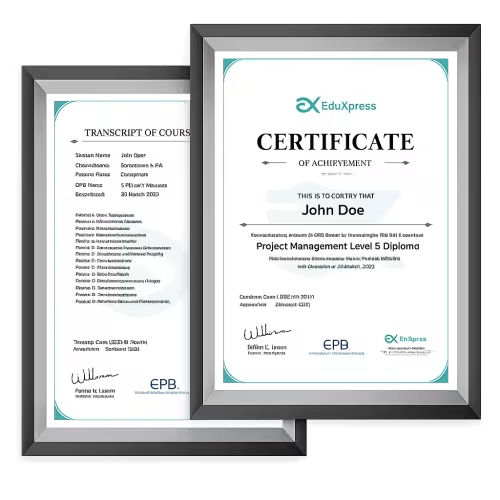
Following successful completion, you can order an EduXpress digital CPD certificate documenting your achievement in the Computer Science with Python Course. An optional printed certificate is available for £24.99. Your certificate recognises structured online learning and supports your continuing professional development record in Python programming, computer science, data analysis and artificial intelligence.
Frequently Asked Questions
What is the Computer Science with Python Course?
Is this Python programming course suitable for beginners?
Do I need previous coding experience to learn Python?
What programming concepts will I learn in this course?
Does the course cover data structures and algorithms?
Will I learn data analysis and visualisation using Python?
Does this Python course include artificial intelligence and machine learning?
What is the difference between artificial intelligence and machine learning?
Will I learn how to build AI models with Python?
Does this course cover generative AI and natural language processing?
Can Python be used to develop chatbots and AI applications?
What will I learn in the final Python-based AI application project?
Can learning Python help me explore careers in software development and data science?
How is the Computer Science with Python Course assessed, and will I receive a certificate?
Curriculum
- 1 Section
- 10 Lessons
- Lifetime
- Computer Science with Python10 Items
- 1.1Module 01: Introduction to Computer Science and Python Programming
- 1.2Module 02: Python Fundamentals, Variables and Data Types
- 1.3Module 03: Control Flow, Functions and Object-Oriented Programming
- 1.4Module 04: Data Structures and Algorithms Using Python
- 1.5Module 05: File Handling, Databases and Data Management
- 1.6Module 06: Data Analysis and Visualisation with Python
- 1.7Module 07: Introduction to Artificial Intelligence and Machine Learning
- 1.8Module 08: Building AI Models with Python
- 1.9Module 09: Generative AI, Natural Language Processing and AI Applications
- 1.10Module 10: Final Project – Developing a Python-Based AI Application