

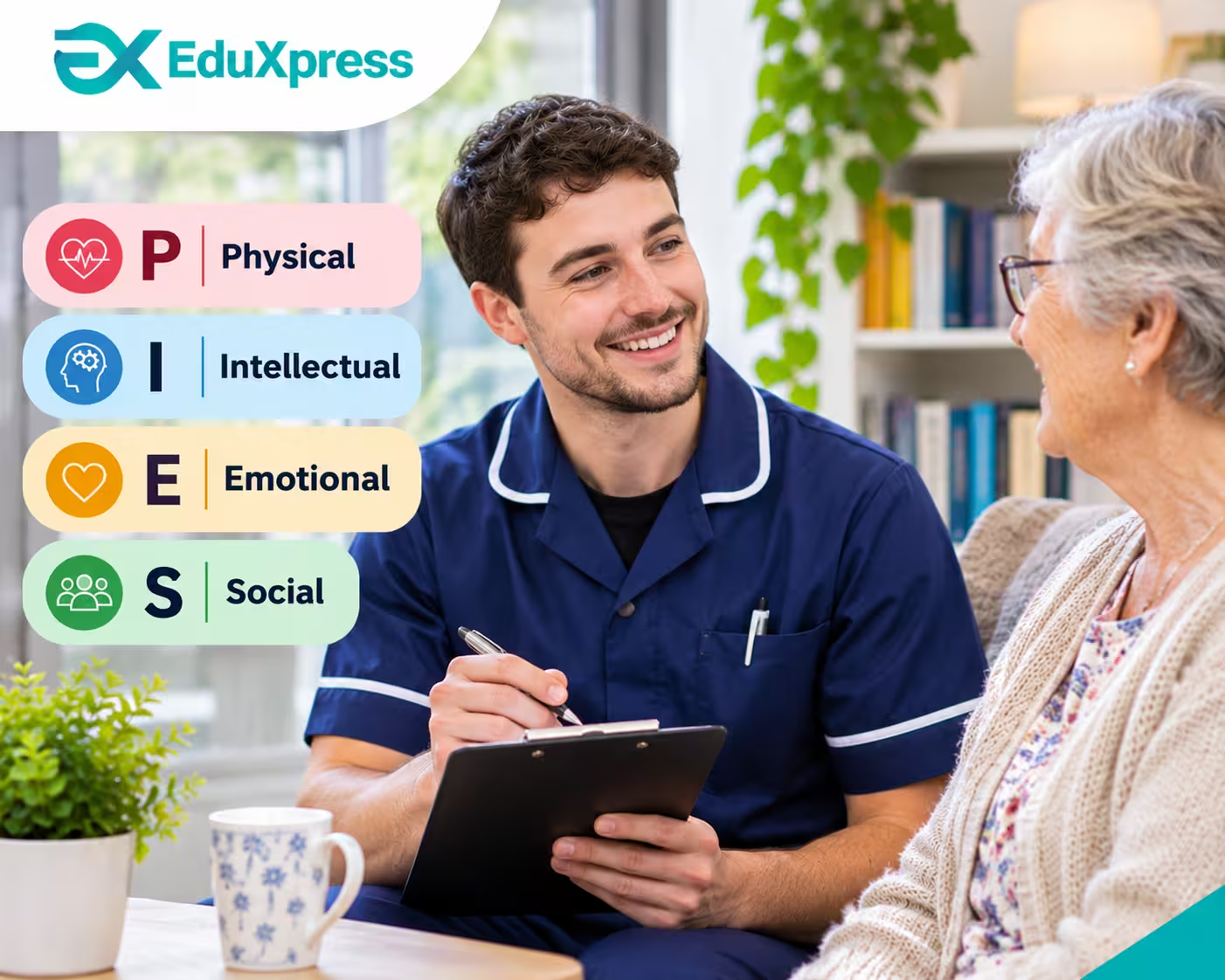
PIES in health and social care stands for Physical, Intellectual, Emotional and Social development or needs. It is a framework that helps learners and care workers understand the different aspects of a person’s wellbeing, rather than focusing exclusively on physical health or medical conditions.
For example, an older adult recovering from a fall may need mobility support, help understanding their rehabilitation plan, reassurance about returning home and opportunities to reconnect with friends. Looking at all four PIES areas helps the care team recognise how these needs influence one another.
This UK-focused guide explains each part of PIES, why it matters, how needs change across different life stages and how professionals can apply the framework in everyday care. It also includes realistic examples, an original PIES assessment worksheet and practical tips for person-centred care planning.
What Is PIES in Health and Social Care?
PIES is a simple way of organising four interconnected areas of human development and wellbeing. It is frequently used in health and social care education to help learners consider how people’s needs evolve throughout life.
The framework is also useful when discussing holistic care. Holistic care means understanding the person as a whole, including their health, abilities, relationships, experiences and preferences.
| PIES area | What it covers | Care example |
|---|---|---|
| Physical | Body, health, movement, nutrition and rest | Supporting safe mobility |
| Intellectual | Thinking, understanding, memory and learning | Explaining a care routine clearly |
| Emotional | Feelings, confidence, reassurance and security | Listening to worries about treatment |
| Social | Relationships, belonging and participation | Supporting chosen social contact |
PIES is not a scoring system that decides someone’s worth, ability or eligibility for support. It is a prompt for thinking broadly and avoiding assumptions.
For a wider introduction to the sector, explore what health and social care means in the UK.
Physical Needs: Supporting Health, Mobility and Independence
The physical element of PIES concerns the body, physical development, health conditions and activities of daily living. It can include nutrition, hydration, sleep, personal hygiene, mobility, pain and access to appropriate healthcare.
Physical needs differ significantly between individuals. A young child may be developing coordination and movement skills, while an older adult may need equipment or support to maintain mobility safely.
In care settings, workers might assist with meals, follow an agreed mobility plan, observe changes in appetite or report new discomfort to a qualified professional.
However, physical support should encourage independence wherever appropriate. For example, helping someone choose their clothes and dress themselves with suitable assistance may preserve confidence and dignity more effectively than automatically completing every task for them.
Practical question: What can this person safely do independently, and what support would help them maintain or improve that ability?
Intellectual Needs: Understanding, Learning and Decision-Making
Intellectual development includes thinking, memory, communication, reasoning, problem-solving and learning. In health and social care, it also involves helping people understand information and participate in decisions affecting their lives.
For example, a support worker may explain an appointment using simple language, pictures or written instructions, depending on the individual’s communication preferences.
Meaningful activities can also help people remain engaged. Reading, conversation, music, familiar hobbies and learning new skills may be useful when they reflect the person’s interests.
Intellectual support must not be confused with testing intelligence. Someone with a learning disability, dementia or communication difficulty still has individual strengths, preferences and rights.
Care workers should not assume that difficulty communicating means a person cannot understand or make decisions. They should use appropriate support and follow relevant consent and mental-capacity procedures.
Practical question: What communication or learning support would help this person understand their options and express their choices?
Emotional Needs: Confidence, Security and Psychological Wellbeing
The emotional aspect of PIES focuses on feelings, emotional security, self-esteem and the ability to cope with difficult experiences. People receiving care may experience uncertainty, frustration, grief, anxiety or reduced confidence.
A hospital patient may worry about a medical procedure. A care-home resident may feel unsettled after moving away from familiar surroundings. A person receiving home support may feel embarrassed about needing help with personal tasks.
Care workers can respond by listening patiently, explaining what will happen, respecting choices and involving suitable professionals when additional support is needed.
Emotional wellbeing should not be reduced to whether someone appears cheerful. Some people express distress through withdrawal, irritability, changes in routine or different communication patterns.
Workers should observe and report concerns without diagnosing mental health conditions beyond their role. Urgent concerns about safety or serious deterioration require appropriate escalation.
Practical question: What matters to this person’s sense of security, control and emotional comfort?
Why Is PIES Important in Health and Social Care?
PIES matters because people’s experiences cannot be fully understood through a single aspect of health or development. Physical conditions, emotional wellbeing, thinking and social circumstances can influence one another.
Using PIES as a learning and reflection framework can help care workers:
- Consider the whole person: Recognise needs beyond immediate physical symptoms.
- Support person-centred care: Pay attention to personal goals, strengths and preferences.
- Improve communication: Identify when someone needs reassurance or accessible information.
- Notice changing needs: Observe patterns that may require care-plan review.
- Encourage independence: Support meaningful participation and appropriate choice.
- Coordinate support: Communicate relevant concerns to authorised team members.
The framework is most useful when it encourages genuine conversations rather than becoming a rigid checklist. A person’s wishes and assessed needs should guide the support offered.
How Do the Four PIES Areas Affect One Another?
PIES areas overlap. A change in one dimension may influence others, but the relationship differs between individuals.
For example, someone recovering from surgery may temporarily struggle with mobility. They might then miss regular social activities, feel frustrated and need clearer information about the stages of recovery.
That single situation involves physical, social, emotional and intellectual needs.
Example: One Change, Four Possible Effects
Physical: Reduced mobility after an operation.
Intellectual: Needs accessible rehabilitation instructions.
Emotional: Feels worried about losing independence.
Social: Cannot attend a valued weekly activity.
The care team’s response should consider these connections, but it should not assume every person experiences them in the same way. Ask, listen and assess rather than predicting someone’s feelings solely from their diagnosis.
PIES Development Across Different Life Stages
PIES is commonly taught as a way of understanding human growth and development from infancy to later adulthood. Each life stage can involve changes in physical abilities, thinking, emotions and relationships.
| Life stage | Possible PIES considerations |
|---|---|
| Infancy and childhood | Movement, language, attachment, play and early friendships. |
| Adolescence | Physical changes, independent thinking, identity and peer relationships. |
| Adulthood | Health routines, learning, changing responsibilities and personal relationships. |
| Later adulthood | Maintaining independence, intellectual engagement, emotional adjustment and valued social connections. |
These are examples, not fixed developmental rules. People develop at different rates and experience different circumstances. Disability or older age should not automatically be equated with dependence or reduced intellectual ability.
Real-Life Examples of PIES in Health and Social Care
The following fictional scenarios illustrate how care teams might use PIES to structure observations and conversations. Actual care decisions must follow individual assessments, professional responsibilities and organisational procedures.
Hospital Care: Recovery Following Surgery
A patient is recovering from surgery and feels uncertain about managing daily activities after discharge.
Physical: Follow the agreed recovery and mobility plan.
Intellectual: Explain discharge instructions in an accessible way.
Emotional: Listen to worries and provide reassurance.
Social: Discuss preferred support at home and relevant community services.
Care Home: A Resident Withdraws From Activities
An older resident who previously enjoyed conversation begins avoiding the dining room and group activities.
Physical: Report possible pain, fatigue or other changes.
Intellectual: Check whether communication or understanding has changed.
Emotional: Ask privately how the resident feels.
Social: Explore whether the resident wants different opportunities for contact.
Home Support: An Adult Wants Greater Independence
A disabled adult wants to prepare more meals independently and reconnect with a local community group.
Physical: Assess suitable kitchen access and safe support.
Intellectual: Present choices and instructions in their preferred format.
Emotional: Respect the person’s goals and encourage confidence.
Social: Explore transport or other practical barriers to participation.
These scenarios show why care workers should avoid relying on a single explanation for a change in behaviour. Someone declining activities may be tired, in pain, worried, uninterested or experiencing several factors simultaneously.
How Can Care Workers Apply PIES in Everyday Practice?
Begin with the person rather than the framework. Ask about what matters to them, their daily routines, preferences, abilities and current concerns. PIES can then help organise relevant information.
A practical approach involves listening carefully, observing factual changes, checking the existing care plan and communicating concerns through approved routes.
For example, instead of assuming a resident needs more social activities, ask which activities they enjoy and whether something has changed. A decline in participation might require a healthcare review rather than a revised entertainment timetable.
Care workers should distinguish everyday observations from professional assessments. They can record what a person says, what they observe and what action they take, without independently diagnosing a condition.
Where urgent safeguarding or clinical concerns arise, follow the relevant escalation process immediately. Completing a PIES checklist must never delay necessary help.
Practical PIES Assessment Worksheet for Care Workers
This original worksheet provides a structured learning exercise. It can help students and care staff consider different needs before discussing them with an authorised colleague or preparing appropriate care-plan recommendations.
| Area | Questions to consider | Possible next step |
|---|---|---|
| Physical | Have mobility, appetite, sleep or daily abilities changed? | Report relevant changes and follow the agreed care plan. |
| Intellectual | Does the person understand information and have suitable communication support? | Use accessible communication and seek advice if needs change. |
| Emotional | What feelings or concerns has the person expressed? | Listen, respect choices and escalate concerns appropriately. |
| Social | Which relationships and activities matter most to them? | Explore preferred opportunities and practical barriers. |
How to use it: Record the individual’s own words where possible, note factual observations, identify strengths and discuss proposed support with the appropriate professional. Avoid recording unnecessary personal information.
Using PIES to Create a Person-Centred Care Plan
PIES can help identify areas worth considering, but a care plan must explain the individual’s actual needs, preferences, agreed outcomes and support arrangements.
Imagine a resident called Margaret who reports feeling lonely since moving into a care home. She enjoys gardening but does not want to join large group activities.
A weak care-plan statement might read: “Encourage Margaret to socialise more.”
A stronger statement would describe her goal and choices: “Margaret would like to spend time in the garden twice a week when she feels well. Staff will discuss accessible gardening activities with her, offer assistance according to her agreed mobility plan and review whether she enjoys the arrangement.”
This example addresses physical access, personal interests, emotional comfort and preferred social participation without forcing unwanted activities.
A good plan should also specify who provides support, relevant risks, review arrangements and how the person’s feedback will be considered.
For a detailed writing framework, read our person-centred care plan guide with practical UK examples.
How Does PIES Relate to UK Health and Social Care Standards?
PIES is a recognised learning framework, but it is not itself a statutory assessment form or a separate legal requirement for care providers.
In England, CQC Regulation 9 requires person-centred care based on an assessment of individual needs and preferences.
CQC guidance explains that assessments should consider the person’s wider needs, including emotional, social, cultural, religious and spiritual aspects, as relevant.
Likewise, Skills for Care emphasises placing people, their preferences and their communities at the heart of care and support.
These expectations align with the holistic thinking encouraged by PIES, but they extend beyond four categories. Cultural identity, spirituality, communication accessibility, safeguarding and individual rights must not be overlooked simply because they do not appear as separate letters.
The Care Certificate also supports person-centred working. Its fifth standard addresses working in a person-centred way, while other standards cover communication, privacy, dignity and safeguarding.
Regulatory arrangements differ across England, Scotland, Wales and Northern Ireland, so providers must follow the rules applicable to their location and service.
Common Mistakes When Using the PIES Framework
Focusing only on physical needs: An individual may receive adequate practical assistance but still need better communication, reassurance or opportunities for meaningful connection.
Making assumptions based on age: Older adulthood does not automatically mean poor memory, loneliness or dependence. Each person requires individual consideration.
Confusing intellectual needs with intelligence: The intellectual area includes learning and understanding. It must not be used to label or stereotype people.
Forcing social participation: Some people prefer quiet activities or smaller social circles. Their choices should be respected.
Using PIES instead of professional assessment: PIES can organise thinking, but clinical concerns, safeguarding issues and care needs require appropriate assessment and action.
Ignoring what the person says: The individual’s own priorities should shape support. A completed checklist does not prove that person-centred care has taken place.
Failing to review changes: Needs and preferences may change after illness, bereavement, a move or another significant life event. Care planning should be reviewed accordingly.
Explore Health and Social Care Courses at EduXpress
Understanding physical, intellectual, emotional and social needs is useful for learners considering care work and professionals developing their knowledge of person-centred support.
These three EduXpress online courses explore relevant care topics, including communication, individual needs, dignity and care planning.
Prices checked on 24 November 2026. Please verify the current checkout total and course information before purchasing.
Frequently Asked Questions About PIES in Health and Social Care
Final Thoughts: PIES Helps Us Understand the Whole Person
PIES stands for Physical, Intellectual, Emotional and Social development or needs. It provides a helpful structure for understanding how different aspects of wellbeing connect and why effective care must look beyond a single symptom or condition.
The strongest approach combines PIES thinking with proper assessment, active listening, individual preferences, appropriate professional support and regular care-plan reviews.
For care workers and learners, the central lesson is simple: understand what matters to the person, identify their needs and strengths, and provide support that respects their choices and independence.
Related EduXpress reading:
How to Write a Person-Centred Care Plan |
Why Confidentiality Matters in Care |
Health and Social Care FAQs.
Sources and review:
CQC Regulation 9;
Skills for Care;
NICE Guidance NG32. Reviewed 24 November 2026. The fictional examples are educational and do not replace individual professional assessment or approved care procedures.

Social Needs: Relationships, Belonging and Participation
Social needs involve relationships with family, friends, carers and the wider community. They also include belonging, personal identity, participation and opportunities to maintain meaningful connections.
For some individuals, social wellbeing means attending community activities. For others, it may involve a weekly telephone conversation, spending time with a close friend or enjoying a quiet hobby alongside someone they trust.
Care workers can support the person’s preferred activities, identify barriers to participation and help them maintain relationships when appropriate.
However, being socially supported does not mean being forced to join group activities. A person who prefers quiet time should not automatically be labelled isolated or uninterested.
NICE guidance on older people’s independence and mental wellbeing encourages meaningful activities that reflect individual interests and preferences.
Practical question: Which relationships and activities does this person value, and what assistance would help them maintain those connections?