
The number of teaching assistants employed in state-funded schools in England has grown almost every single year since records began…
The number of teaching assistants employed in state-funded schools in England has grown almost every single year since records began in 2011/12, rising from 221,500 to 288,800 in 2024/25 — a remarkable 30% increase over little more than a decade. Explore Education Statistics. This isn’t a stagnant profession; it is one of the most consistently expanding roles in the entire education sector.
The growth shows no sign of slowing. Total support staff in schools reached 517,500 FTE in 2024/25, surpassing even the previous peak recorded in 2015/16, with the latest annual rise driven primarily by an increase of 5,900 teaching assistants. Explore Education Statistics
The demand is being supercharged by the rise of Special Educational Needs provision. There are now 1.7 million pupils in England identified as having SEND — 18% of the total student population — and the number of pupils with an Education, Health and Care (EHC) plan rose by 11.5% between 2023 and 2024, reaching 576,474. Every one of those pupils requires dedicated classroom support, and trained SEN teaching assistants are at the centre of that provision.
Analysis of job listings across Indeed, Totaljobs, and Reed found that teachers and teaching assistants ranked among the most in-demand roles across the entire UK, with the education sector continuing to face overwhelming staff shortages.
Where do TAs actually work? Around 69% of teaching assistants work in primary schools, with 16% in secondary schools and 15% in special schools and alternative provision settings. Explore Education Statistics And it’s worth noting who currently fills these roles: 92% of teaching assistants are female, making it one of the most female-dominated workforces in any UK profession — though this is gradually changing as more career changers from diverse backgrounds enter the field. Explore Education Statistics
What does all this mean for you? Simply put, if you’re considering a career as a teaching assistant, you are entering one of the most in-demand, consistently growing roles in UK education — with clear pathways to progress, specialise, and increase your earning potential. The rest of this guide will show you exactly how to get started.
A teaching assistant — commonly referred to as a TA — works alongside a qualified teacher to support pupils’ learning, wellbeing, and development in the classroom. It is a hands-on, people-focused role that sits at the very heart of how UK schools function day to day.
If you’ve ever wondered what a teaching assistant job description actually looks like in practice, here is what a typical working day involves:
What makes the teaching assistant role description so appealing — particularly to career changers — is its variety. No two days are the same. You might be reading one-to-one with a reluctant reader in the morning and running a craft activity for a group of Year 3 pupils in the afternoon.
Schools advertising teaching assistant jobs typically look for candidates who are patient, adaptable, and genuinely passionate about helping children thrive — qualities that matter far more than a formal academic background.
One of the most important things to understand before searching for teaching assistant jobs is that “TA” is not a one-size-fits-all title. There are several distinct types of roles, each with different responsibilities, required qualifications, and pay grades.
| Role | Overview | Key Requirements / Notes |
|---|---|---|
| General / Classroom Teaching Assistant | Supports whole-class lessons, helps pupils who are falling behind, and ensures smooth classroom operation. Ideal entry-level role. | No prior experience required; perfect starting point for new entrants. |
| Higher Level Teaching Assistant (HLTA) | Plans and delivers lessons, covers for teachers, and mentors junior staff. | Requires experience + recognised HLTA qualification. |
| SEN Teaching Assistant | Provides support to pupils with autism, ADHD, dyslexia, and other additional needs. | High demand role; may require specialist SEN training. |
| 1:1 Support Assistant | Works exclusively with one pupil, often with an EHC plan, offering consistent personalised support. | Requires patience, consistency, and strong relationship-building skills. |
| Early Years Teaching Assistant | Supports children aged 3–5 through play-based learning and early development. | Level 2 or Level 3 Early Years qualification often preferred. |
This is one of the first questions people ask — and the honest answer is reassuring. You do not need a university degree to become a teaching assistant in the UK. The role is genuinely accessible to career changers, parents returning to work, and school leavers alike, without years of academic study standing between you and your first position.
That said, most schools do have a baseline set of expectations when hiring. The minimum qualifications for a teaching assistant role that employers commonly look for include:
While these are the minimum requirements, the reality of today’s job market is competitive. Schools increasingly favour candidates who hold a recognised teaching assistant qualification alongside their application. Holding a formal TA certificate — particularly at Level 2 or Level 3 — signals to a hiring school that you are serious about the role, understand classroom practice, and are ready to contribute from day one.
There are three main qualification levels to be aware of:
Technically, no. There is no single nationally mandated qualification that every TA must hold before entering the classroom. However, “not mandatory” should not be read as “not important.”
In practice, the majority of schools now list a relevant TA qualification as either a requirement or a strong preference in their job advertisements. Candidates without one are frequently overlooked at the shortlisting stage — not because they lack ability, but because a qualified candidate sitting alongside them on the pile makes the hiring decision straightforward.
The good news? Teaching assistant qualifications are affordable, flexible, and faster to complete than most people expect. Many are available entirely online, meaning you can study around existing work, childcare, or other commitments and be job-ready in a matter of months.
In the next section, we’ll break down exactly which TA courses are available, what each level covers, and how to find accredited training that fits your schedule.
If you’ve read this far and thought “I want this — where do I actually start?” — here is the answer.
The Online Teaching Assistant Course – Level 3 from EduXpress is one of the most comprehensive teaching assistant training online programmes available in the UK today. It covers everything a school hiring manager wants to see — and everything you need to walk into a classroom with confidence.
This is not a short introductory taster. With 70 lessons across 5 in-depth sections and over 15 hours of learning, it is a full professional development programme built around the real demands of the teaching assistant job description. Here is what you will study:
What separates this teaching assistant level 3 course from shorter alternatives is its depth in SEN provision. Given that 1.7 million pupils in England are now identified as having SEND, schools are not just looking for TAs — they are specifically looking for TAs who understand how to support pupils with autism, ADHD, and dyslexia. This course covers all three in detail, giving you a significant advantage when applying for roles.
Here is what you get when you enrol:
Whether you are a career changer, a parent returning to work, a classroom volunteer looking to formalise your experience, or a support worker moving into education, this course was built around your life.

The Online Teaching Assistant Course – Level 3 is a complete professional training programme designed to prepare you for real UK classroom environments. With 70 lessons and 15+ hours of structured learning, it builds both confidence and employability.
Enrol Now →Having the right qualification is only half the battle. Knowing where to look, how to present yourself, and what schools are genuinely searching for is what separates candidates who land interviews from those who hear nothing back. This section walks you through the entire job-hunting process — from the best places to search for teaching assistant jobs to what your CV needs to say to get you shortlisted.
There are several reliable platforms where job teaching assistant vacancies are listed regularly across England, Scotland, Wales, and Northern Ireland. Each serves a slightly different purpose, so using a combination will give you the widest possible view of what is available in your area.
Because there is a growing number of applicants for teaching assistant positions, schools can be increasingly selective, favouring candidates who hold relevant qualifications. This makes the preparation you put into your application as important as the experience itself.
A strong teaching assistant job description response — whether in a CV or personal statement — should demonstrate the following:
On your CV:
In your personal statement or cover letter:
Developing a specialism can significantly increase your chances of securing a role — areas such as special education, behaviour management, and language support are consistently in demand, and highlighting a specific interest on your CV and cover letter demonstrates commitment and adaptability.
Understanding the teaching assistant role description schools publish in their job advertisements gives you a significant edge when tailoring your application. While every school is different, the core responsibilities that appear in most teaching assistant job postings include:
When you read these responsibilities and then look back at what a Level 3 teaching assistant course covers — SEN support, behaviour management, safeguarding, assessment, phonics, communication skills — the alignment is direct and deliberate. Completing your training is not just about gaining a certificate; it is about being genuinely prepared for every item on that list.
If you are just starting out and finding it difficult to secure a permanent position without direct classroom experience, supply TA work is one of the smartest moves you can make. Supply agencies place qualified TAs in schools on a daily or short-term basis, giving you the chance to build real classroom experience across multiple school settings, age groups, and SEN environments — all while getting paid.
Many permanent TA appointments are made from supply staff who have already proven themselves in that school. It is one of the most reliable routes from qualification to a permanent contract, particularly for those who are new to the profession.
Teaching assistant pay is one of the first questions every prospective TA asks — and rightly so. Understanding the salary structure before you commit to a career path allows you to plan with clarity, set realistic expectations, and identify exactly which qualifications and specialisms will increase your teaching assistant income over time.
The honest answer is that TA pay varies depending on your level, experience, school type, and location. But the structure is transparent, the progression is clear, and for those willing to qualify and specialise, the earning potential is meaningfully higher than many people expect.
Most teaching assistants in the UK are paid under the National Joint Council (NJC) pay scale — a nationally agreed framework used by local authorities to determine salaries for school support staff. Maintained schools typically follow the Local Government Association NJC pay scales, while academies and free schools may set their own pay structures, though the majority still use NJC as their benchmark.
The NJC system assigns pay based on Spinal Column Points (SCPs) — a series of pay bands that increase with your level of responsibility, qualifications, and experience. What this means in practice is that your salary does not stagnate. Every time you take on more responsibility, gain a higher qualification, or move into a specialist role, there is a clearly defined pay band waiting for you.
The NJC confirmed a 3.2% pay rise for most TAs and support staff from 1 April 2025, and the current NJC offer for 2026 proposes a further 3.3% consolidated pay rise across pay points 3 to 43, with the lowest pay point being deleted from April 2026 — raising the minimum pay floor for entry-level staff.
Here is a clear breakdown of teaching assistant pay across every level, based on current NJC rates and published salary data:
| Role Level | Typical Annual Salary (FTE) | Notes |
|---|---|---|
| Level 1 TA | £18,000 – £21,000 | Entry-level; limited prior experience required |
| Level 2 TA | £21,000 – £24,000 | Small group support; some independent classroom work |
| Level 3 TA | £23,000 – £26,000 | Most common hire level; specialist classroom knowledge |
| SEN Teaching Assistant | £19,000 – £26,000 | Higher pay reflects specialist SEN support demand |
| HLTA | £24,000 – £31,000 | Advanced responsibilities including lesson delivery |
Teaching assistant salary in the UK in 2026 typically falls between £12.50 and £16.50 per hour depending on role level, experience, location, and employer — equating to roughly £23,000 to £29,000 per year at full-time equivalent before term-time adjustments.
For HLTAs, job listings in 2025 showed salaries between £24,000 and £31,000 depending on location and responsibilities, reflecting the greater autonomy and curriculum contribution this role involves.
This is the detail that catches many new TAs off guard. The salary figures above are full-time equivalent (FTE) figures — meaning they represent what you would earn if you worked 52 weeks a year. The reality is that most teaching assistants are employed on term-time only contracts, working roughly 38 to 39 weeks of the year.
An FTE salary of £25,500 may result in actual take-home pay of £18,500 to £20,000 on a term-time contract — not because the hourly rate is reduced, but because the number of paid weeks is lower. Your hourly rate remains the same; you simply work and are paid for fewer weeks annually.
This is worth understanding clearly before comparing a TA salary to a full-year role in another sector. The trade-off, of course, is that you receive school holidays — a benefit that holds considerable value for parents and those who prioritise work-life balance.
Geography plays a significant role in teaching assistant income. Teaching assistants in London earn an average annual salary of around £24,500, reflecting the higher cost of living — while in cities such as Leeds and Birmingham the average sits near £20,000, and in Manchester around £18,000.
London and the South East attract a London Weighting allowance on top of the standard NJC pay, which is applied automatically for roles in Greater London. If you are based in the capital or considering relocating, this can add several thousand pounds to your annual salary compared to equivalent roles elsewhere in England.
London salaries may include London Weighting allowance, increasing total pay.
Yes — and this is one of the most important things to understand before deciding which level of training to pursue.
The NJC pay scale links your salary band directly to your role level and responsibilities, which in turn are tied to your qualifications. A candidate hired as a Level 3 TA will be placed on a higher pay band from day one than someone hired without a formal qualification into a Level 1 role. Over a full career, that difference compounds significantly.
Level 3 teaching assistants are recognised as experienced classroom professionals who may assist with lesson delivery, track pupil progress, and manage learning activities — all responsibilities that sit within higher NJC pay bands. Holding a Level 3 qualification does not just make you more employable; it determines the band you are placed on when you are hired.
For those looking further ahead, the route from Level 3 to HLTA represents one of the clearest pay progression pathways in any support role within UK education — with HLTA salaries sitting meaningfully above the standard TA scale and scope for continued growth through additional SEN specialisms and responsibility allowances.
Higher qualification directly unlocks higher salary bands and long-term growth.
Everything covered in this blog so far — the qualifications, the courses, the job market, the pay structure — comes together here. This is your clear, practical roadmap from where you are right now to your first day in a UK classroom.
Whether you are starting from scratch with no classroom experience, returning to work after a career break, or transitioning from a completely different profession, these steps apply to you. Follow them in order and you will not just be job-ready — you will be the kind of candidate schools are actively competing to hire.
Before anything else, confirm you meet the minimum entry requirements that schools and training providers expect.
You will need:
If you have these in place, you are ready to move forward immediately. If your GCSEs are the sticking point, address that first — it is a quick fix that unlocks everything else.
This is the step that separates candidates who get interviews from those who do not. As competition for roles increases, qualifications often make the difference between meeting minimum criteria and being shortlisted.
The teaching assistant level 3 course is the qualification most widely recognised by UK schools and the one that places you on the highest entry-level NJC pay band. It covers everything you will encounter in a real classroom — SEN support, behaviour management, safeguarding, phonics, communication skills, curriculum assessment, and professional development planning.
The EduXpress Online Teaching Assistant Course – Level 3 is one of the most comprehensive options available, with 70 lessons across 15+ hours of structured content, dedicated HLTA preparation modules, and deep-dive SEN training covering autism, ADHD, and dyslexia. It is CPD-accredited, fully online, and available for just £29 — making it one of the highest-value investments you can make at this stage of your career.
Most learners complete the course within 4 to 12 weeks studying at their own pace, meaning you can be qualified and actively applying for roles within a single school term.
Qualifications and experience work together. A Level 3 certificate strengthens your application; real classroom experience makes it compelling.
If you have not yet worked in a school setting, consider these routes to building your profile:
Do not underestimate informal experience either. Being a parent who has volunteered at school fairs, helped with reading groups, or supported a child through SEN processes all counts. Frame it in your application with intention.
Once you understand the basics of the TA role, SEN specialisation is the single most powerful step you can take to increase both your employability and your earning potential.
There are 1.7 million pupils in England identified as having SEND — 18% of the total student population — and the number of pupils with an Education, Health and Care plan rose by 11.5% between 2023 and 2024. Schools are under significant and growing pressure to staff SEN provision with trained, knowledgeable professionals, and qualified teaching assistants for SEN roles consistently attract higher pay and more stable long-term employment than general classroom TA positions.
What SEN specialisation involves:
A strong SEN TA understands the four broad categories of need recognised in the UK SEND Code of Practice — Communication and Interaction (autism, speech and language needs), Cognition and Learning (dyslexia, dyscalculia), Social, Emotional and Mental Health (SEMH), and Sensory and Physical needs. Level 3 is particularly valued for SEN roles, especially for one-to-one support, and specialist training such as autism awareness or ADHD support significantly strengthens applications.
The ability to communicate using British Sign Language or Makaton can also be helpful, and schools will often provide additional training in these once you are in post. National Careers Service
The EduXpress Level 3 course covers all of this in depth — with dedicated module sequences on autism spectrum disorder, ADHD across childhood, adolescence, and adulthood, dyslexia, sensory and physical needs, and social-emotional mental health difficulties. If SEN is the direction you want to take, this course gives you the foundation schools are looking for before you even walk through the door.
Your CV is your first impression, and in a competitive application pool, presentation matters as much as content.
Your TA CV should include:
Your personal statement should answer three questions every hiring manager is silently asking: Why teaching? Why this school? Why are you ready? Research the school’s Ofsted report, their SEND provision, and their ethos — and reference them specifically. Generic applications are identifiable immediately and routinely passed over.
With your qualification, experience, and CV in place, begin your active job search using the platforms covered in Section 4 — Teaching Vacancies (GOV.UK), TES, Indeed, Reed, and your local authority website.
Set up job alerts for your preferred location and role type so new listings reach you the moment they are posted. Apply consistently and tailor each application rather than using a single template across all schools.
When you reach interview stage, expect to be asked about:
Prepare responses that demonstrate passion, adaptability, and teamwork — and share real examples of how you have supported others, managed responsibilities, and handled challenging situations.
Landing your first TA role is not the end of the journey. It is the beginning of a career with genuine upward mobility.
With experience, you could take a course to become a Higher Level Teaching Assistant — and with further study, you could train to become a fully qualified special educational needs or mainstream teacher.
The most common progression routes from a TA role include:
Many people who begin as teaching assistants go on to become the most experienced, valued, and well-paid members of their school’s support team. The career trajectory is real — and it starts with the decision to qualify.
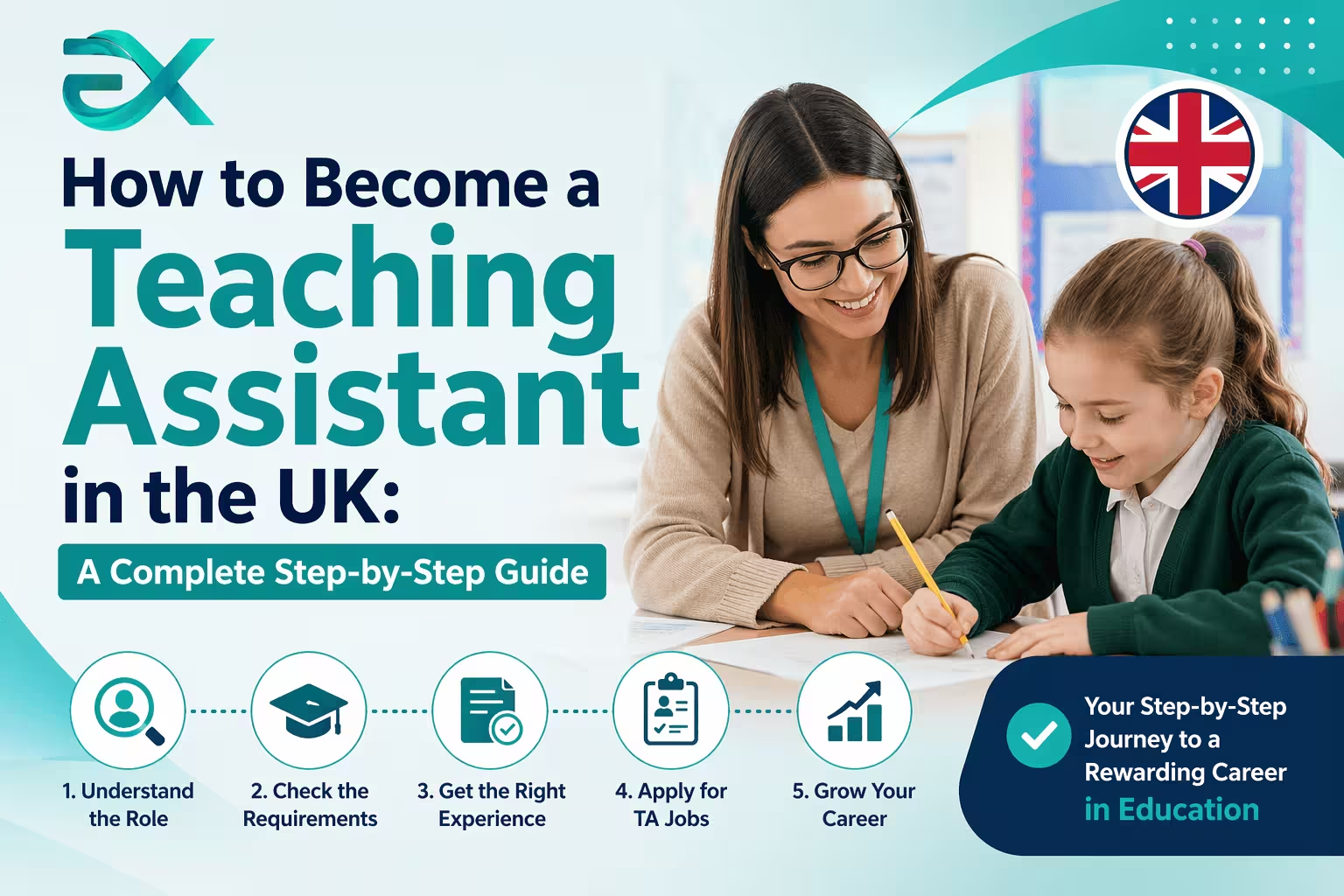
Check GCSEs / Functional Skills + DBS eligibility
Complete Level 3 Teaching Assistant Course
Gain classroom experience (volunteering / supply work)
Specialise in SEN (Autism, ADHD, Dyslexia, SEMH)
Apply for TA roles across UK schools
Progress to HLTA, SENCO or Teacher pathways
Becoming a teaching assistant in the UK is one of the most accessible, rewarding, and genuinely future-proof career moves you can make right now. The demand is real, the pathway is clear, and — as this guide has shown — the barriers to entry are lower than most people assume.
Thousands of people make this career transition successfully every single year — many of them starting from exactly where you are right now.
You do not need a degree. You do not need years of prior experience. What you do need is the right qualification, a genuine passion for supporting children’s learning, and the confidence to take the first step.
Every year, thousands of people successfully transition into teaching assistant roles — many starting with no classroom experience at all.
“I thought I needed a degree or years of experience. Within months, I qualified and started working in a local school.”
— Sarah M., Teaching Assistant (London)“I made a complete career change. The training was simple, and I was surprised how quickly I got hired.”
— James R., Teaching Assistant (Manchester)“I started with no experience in education. Now I can’t imagine doing anything else — it’s incredibly rewarding.”
— Ayesha K., Teaching Assistant (Birmingham)You do not need a degree. You do not need years of prior experience.
What you need is a recognised qualification, a passion for supporting children, and the confidence to take the first step.
The real question is not “Can I do this?” — it’s “When will I start?”
Thousands have already made the move into education. You can be next.
Added to cart
Check out our shop to see what's available